


Nekch
النقشTraditional Moroccan engraving on chased metal, executed with the burin in geometric patterns and arabesques. Groove depth 0.3 to 0.5 mm.
Craftsmanship I
المعدن
From raw rolled sheet to sealed patina: eight stages, eight inspection points, and between thirty and sixty-five hours of handmade work depending on the model.
reference files, dimensions, numbered production order
Traceability: each piece is linked to a unique order from the very first minute
Design office
base, staff, crowning star, bending and stamping
Geometric regularity. Final tolerance ± 0.2 mm
Workshop
surface texture, relief that catches the light
The skin of the metal. Even hammering, with no unintended hollows or smooth patches
8 to 25 h
burin, depth 0.3 to 0.5 mm, approved tracing
The soul of the piece. Exclusively handmade, by a qualified artisan
15 to 40 h
silver brazing ≥ 40%, matching fixings
Structural integrity. No chemical bonding in load-bearing areas
Workshop
four passes, grits 240, 600, 1200, buffing
Contrast. The engraved areas are deliberately left matt
Workshop
polished copper, gilded finish
Visual depth. The patina reveals the relief before being sealed under varnish
Workshop
UV acrylic varnish, two crossed coats, ventilated booth
Hallmark beneath the base, serial no. YYYY-MM-XXXX, year of make
Inspection
Craftsmanship I — Plate
ما ينبغي تأمّله

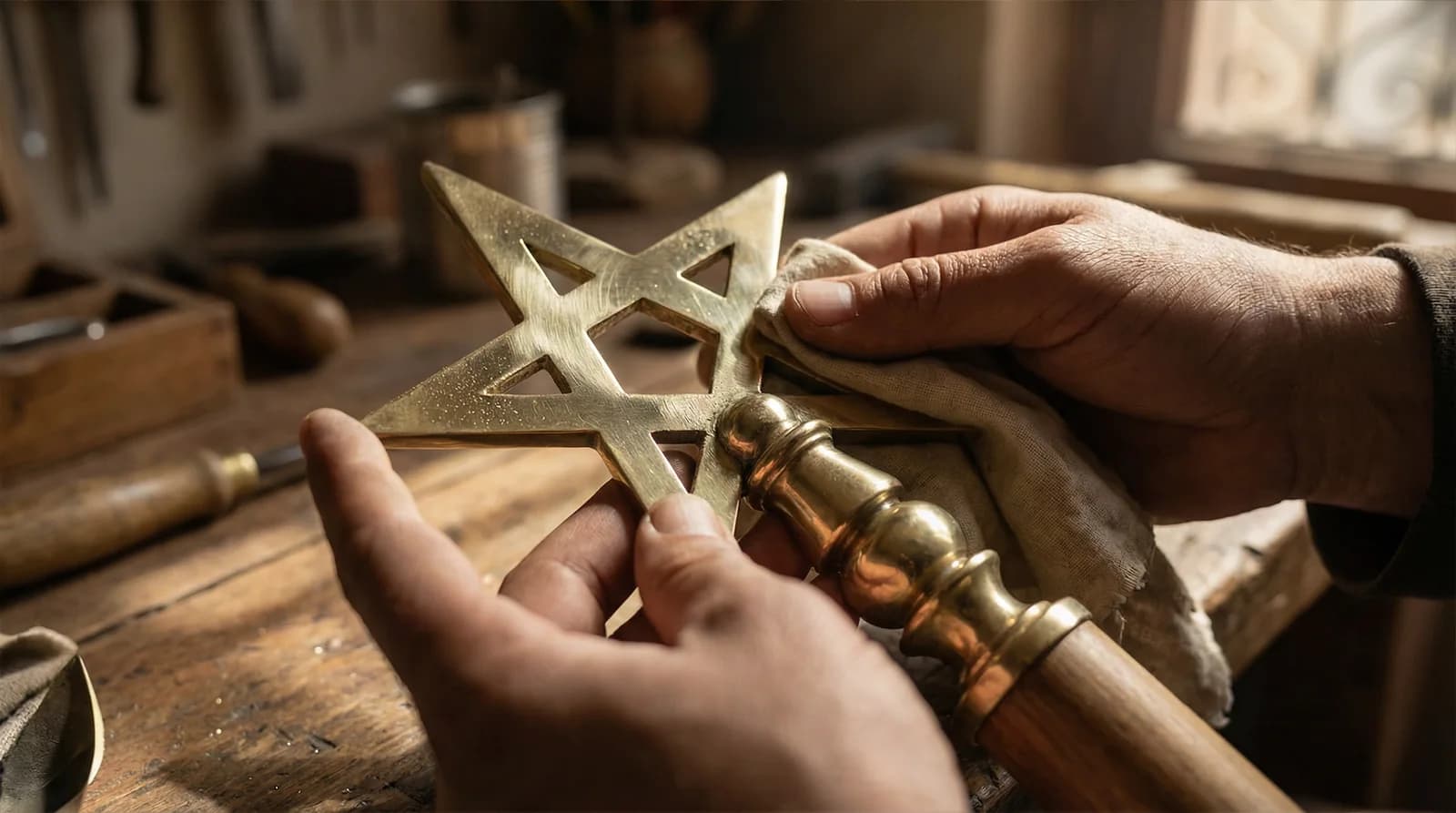
Pentagram in polished chased copper, gilded finish, crowning the staff.
Hammered sheet metal, gilded finish, handmade work; rings and finials engraved according to the Nekch codes.
Pierced filigree base, engraved, handmade work, ensuring the whole stands true.
Craftsmanship II
التطريز
The textile flag is the visual soul of the piece. It is entirely handmade.

The ground is a high-density cherry-red velvet-effect fabric, lined around its entire edge to ensure the body and nobility of the drape. The green pentagrammic star is positioned at the geometric centre, secured by invisible stitching, at a size proportionate to the model.
Around this star the doubled terssane is worked: a double pass of gilt thread forming an even cordonnet that outlines each point of the pentagram. It is the identifying mark of the MHB DECOFES flag, and the most delicate operation in the entire textile process — from six to eighteen hours of work depending on the model.
The borders then receive three tiered ornaments, worked in succession: plain gilt sfifa as the inner edging, sfifa with the ghouza motif as the middle edging, and finally the teryiche — a supple terminal fringe that gives the flag its feather-like effect in movement.
Two chouchates in braided passementerie in the official colours are made separately and suspended from the ring beneath the crowning star.
Contractual vocabulary
معجم التقنيات
Six craft terms. They denote precise gestures, and constitute the vocabulary of reference between the house and those who commission its work.
Traditional Moroccan engraving on chased metal, executed with the burin in geometric patterns and arabesques. Groove depth 0.3 to 0.5 mm.

Braid or border embroidered in gilt thread, forming an ornamental edging along the edges of the flag — or, on the metal, an engraved band.

An ornamental variant of the sfifa: at the tip of the flag, the gilt braid forms a teardrop loop (ghouza), sewn flat onto the velvet.

Gilt-thread embroidery encircling the central star, worked in a double pass to form an even cordonnet. The identifying mark of the range.

Passementerie as a terminal fringe with a feather effect, forming the finish of the lower borders of the flag.

Ornaments of braided passementerie in silk or viscose thread, suspended at the top of the flag beneath the crowning star.
The terms above are those used in the house’s specifications. They are authoritative in any contractual relationship.
The workshop
أيادي الدار


